
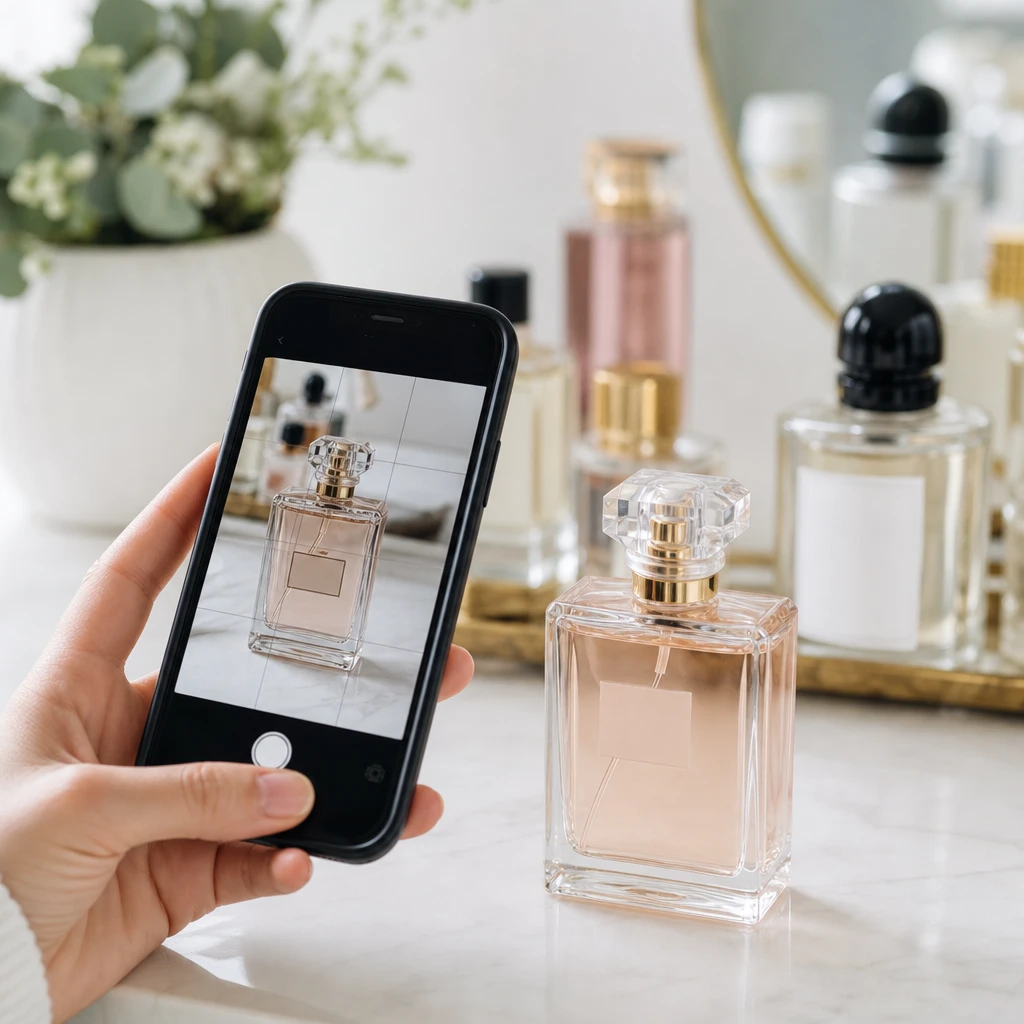
Why “identify perfume by photo” is suddenly the default
If you’ve ever paused a TikTok, zoomed into a vanity shot, or spotted a gorgeous bottle behind a counter and thought, what perfume is this?, you’re not alone. Camera-based search has become a normal way to shop and research—especially in fragrance, where bottle design is often the first clue.
A good perfume identifier app should do more than guess a name. The best experience is: identify the bottle, confirm the exact version, then save it (so you don’t lose the lead the moment you close the app). That’s the collector-friendly workflow we built into N.O.S.E. Notebook: scan → verify → add to your vault → build recommendations around what you actually like.
Step-by-step: how to identify a perfume from a photo (bottle scan)
Bottle scanning works best when you treat it like product photography—clear image, good light, and a few intentional angles.
1) Clean the “identifying surfaces”
Before scanning, quickly wipe the front label and the glass where lettering is etched. Smudges and fingerprints can blur small details like brand marks, concentration labels, or batch-style codes.
2) Use bright, even lighting (avoid glare)
Glossy bottles and metallic labels are the #1 reason scans fail. Stand near a window or use a soft lamp; avoid flash if it creates a white hotspot across the logo. If glare is unavoidable, tilt the bottle slightly so reflections move off the text.
3) Frame the bottle like a product listing
For the most accurate identify perfume by bottle scan:
- Fill most of the frame with the bottle (not your hand).
- Keep the label square to the camera.
- Make sure the cap and shoulders are visible—silhouette matters.
4) Take two photos, not one
A single image might miss the key identifier. Capture:
- Front label (brand + fragrance name)
- Back or bottom (often shows concentration, size, or regulatory text)
If you’re using a perfume scanner feature inside N.O.S.E. Notebook, these two angles dramatically improve matching when multiple flankers share near-identical packaging.
5) Confirm the exact “version,” not just the name
Many people stop at “it’s Dior Sauvage” or “it’s Black Opium”—but the bottle may represent a different concentration or release.
After the scan returns a match, verify:
- Concentration: Eau de Toilette (EDT), Eau de Parfum (EDP), Parfum, Extrait
- Bottle size: 30/50/100 mL (helps distinguish some releases)
- Label wording: “Intense,” “Extreme,” “Elixir,” “Légère,” etc.
This matters because the scent profile, performance, and even note pyramid can shift noticeably between versions.
6) Save it immediately into a fragrance vault
Identification is only half the win. The real value comes from building memory:
- Add the verified bottle to your Fragrance Vault
- Tag where you found it (department store, friend’s shelf, travel)
- Add a quick impression (“smoky vanilla,” “fresh neroli,” “too sweet”) while it’s fresh
Over time, those saves become the raw material for better recommendations, smarter sampling, and fewer accidental duplicates.
“What perfume is this?” Troubleshooting when the scan doesn’t work
Even strong camera identification can miss when the photo lacks details—or when the bottle itself is tricky. Here’s how we troubleshoot the most common failure points.
Problem: The app matches the brand but not the exact fragrance
This is common with brands that use a house silhouette (similar bottle shape across many scents).
Fix: Photograph the front label close-up so the fragrance name is crisp. If the name is tiny, zoom in slightly—but keep it in focus. Then take a second photo of the cap, since cap shape and color frequently indicate the flanker.
Problem: The scan returns multiple look-alikes
Some bottles are essentially “templates” across different lines (and many flankers release every year).
Fix: Look for one of these distinguishing clues and capture it:
- A colored collar ring or ribbon
- A limited-edition badge
- “Intense/Absolu/Elixir” printed under the name
- A gradient tint (clear-to-black, pink-to-red, etc.)
Problem: Reflections hide the logo or name
Mirror-like glass, chrome plates, and metallic labels confuse identification.
Fix: Move to indirect light and tilt the bottle until the reflection slides away from the text. A plain background (white wall, towel) also helps the camera lock focus.
Problem: It’s a mini, a travel spray, or a decant
Minis and travel formats often remove the design cues the scanner relies on.
Fix: Scan the outer box if available. If not, take a clear photo of any printed text on the atomizer or vial and pair it with context clues: brand font style, cap shape, and the color of the juice.
Problem: It’s an older bottle or a reformulated design
Packaging updates happen. A bottle from 2008 may not match today’s listing images.
Fix: Photograph the back label and any secondary marks. Older bottles often retain original language, distributor text, or concentration styling that helps narrow down the era.
Problem: The bottle is unbranded or the label is missing
Sometimes the best friend’s bathroom cabinet special has no label left.
Fix: Focus on what remains:
- Cap material and geometry
- Atomizer style
- Bottle silhouette (rectangular flask, round globe, faceted gem)
- Any embossed logo on the glass
If you also remember the smell, note the most obvious family (fresh citrus, powdery iris, smoky woods, syrupy vanilla). Pairing a visual scan with a quick scent description is often enough to get to a confident ID.
How to avoid false matches (and why they happen)
Most misidentifications come from one of three places: limited image quality, near-identical flankers, or “dupe-style” packaging that imitates luxury cues.
A few habits keep your results reliable:
- Don’t scan from screenshots when possible. Social video stills are often compressed and sharpened, which distorts logos.
- Capture the label text sharply. Shape is helpful; typography is decisive.
- Verify concentration. EDP vs EDT can be a completely different wearing experience.
When in doubt, treat the scan result as a lead—then confirm with a second photo angle and the bottle’s printed details.
From identification to discovery: what to do once you’ve found the bottle
The most satisfying part of identification is what comes next: understanding why you liked it and using that insight to explore intelligently.
Once a perfume is correctly identified, we recommend three quick actions:
- Save it to your vault with a simple rating (love/like/ok/no)
- Add 2–3 vibe tags (clean, cozy, spicy, office, date night, summer)
- Note the standout notes you detect (even if you’re not “trained”)—vanilla, bergamot, sandalwood, rose, incense, musk
That small bit of structure turns a one-time “what is this perfume” moment into a growing personal scent profile—useful for future recommendations and for spotting patterns (for example: loving citrus openings but disliking sugary dry-downs).
A quick checklist for better bottle scans
If you want the fastest path to a solid match, these basics cover most scenarios:
- Bright, even light (minimal glare)
- Front label in focus, filling the frame
- Second photo of back/bottom text
- Capture cap + silhouette
- Confirm concentration (EDT/EDP/Parfum/Extrait)
- Save the verified result into a fragrance vault
Conclusion
Identifying a perfume by photo is easier than ever—but accuracy depends on clear angles, readable label details, and a quick verification step to avoid flanker mix-ups. The real advantage is what happens after the match: saving the bottle, tagging your impressions, and building a personal archive that makes future discovery smarter and more fun.
N.O.S.E. Notebook is built for that full journey—scan to identify, then save and organize what you find in a collector-friendly Fragrance Vault, with recommendations that evolve as your profile grows.
Find your next scent
Explore the fragrance catalog
Browse scent profiles, notes, and houses — or let the Scent Finder match you to a fragrance in four questions.
More from Nose News
All articles →
October 14, 2026
Best Perfume Finder Apps in 2026: AI Recommendations, Bottle Scan, and Your Fragrance Vault
Perfume finder apps have leveled up fast: smarter AI, better bottle scans, and collection “vaults” that help you remember what you own (and what you actually love). Here’s what to look for in 2026—and how to choose the right app for your scent journey.
October 12, 2026
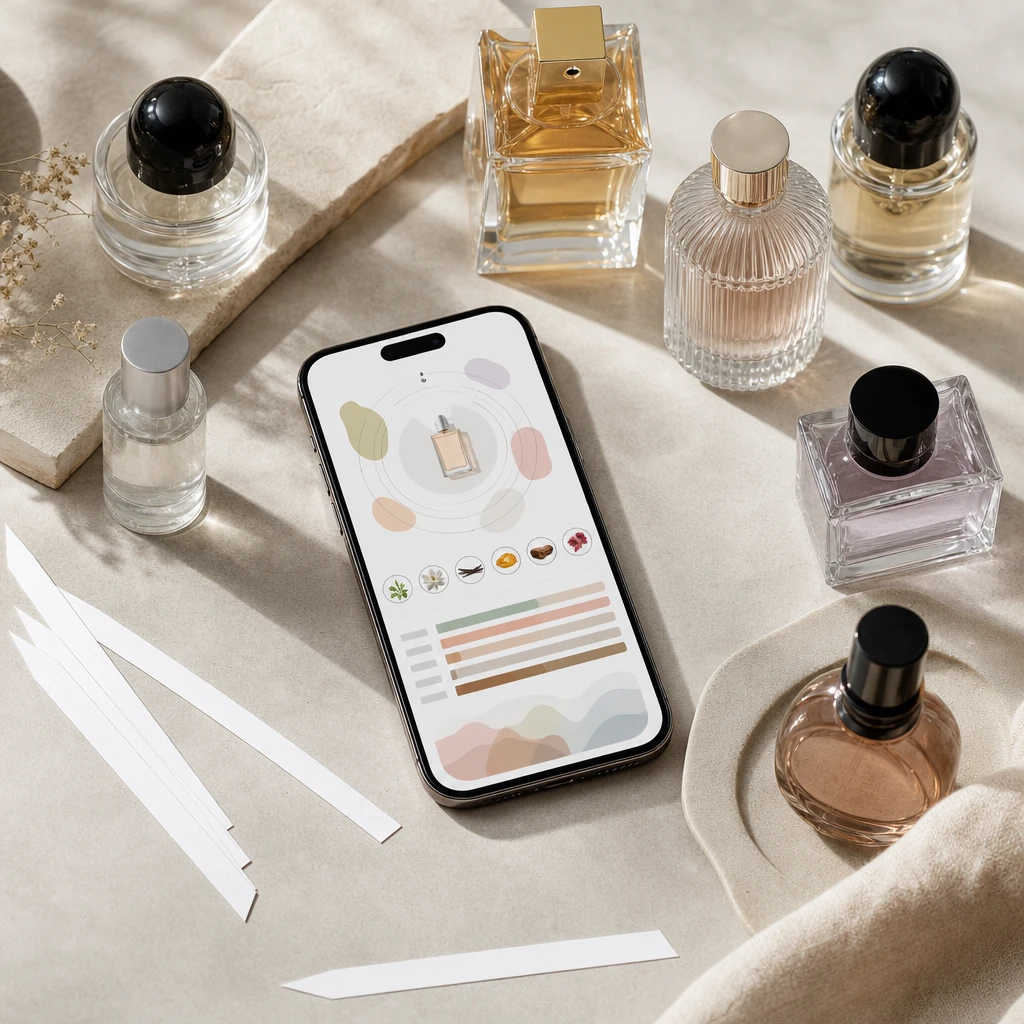
How to Find Your Signature Scent in 2026 (With an AI Scent Profile)
Finding a signature scent doesn’t have to mean buying a dozen discovery sets and hoping something clicks. Here’s a modern, realistic process—powered by a clear scent profile and smarter recommendations.
October 9, 2026
Perfume Scanner Apps (2026): How to Identify a Fragrance From a Photo + Fix Common Scan Errors
Trying to identify a perfume bottle from a photo? Here’s how perfume scanner apps work in 2026, how to scan bottles and labels for accurate matches, and how to fix the most common scan errors—especially when flankers and lookalike bottles confuse results.