
← Nose News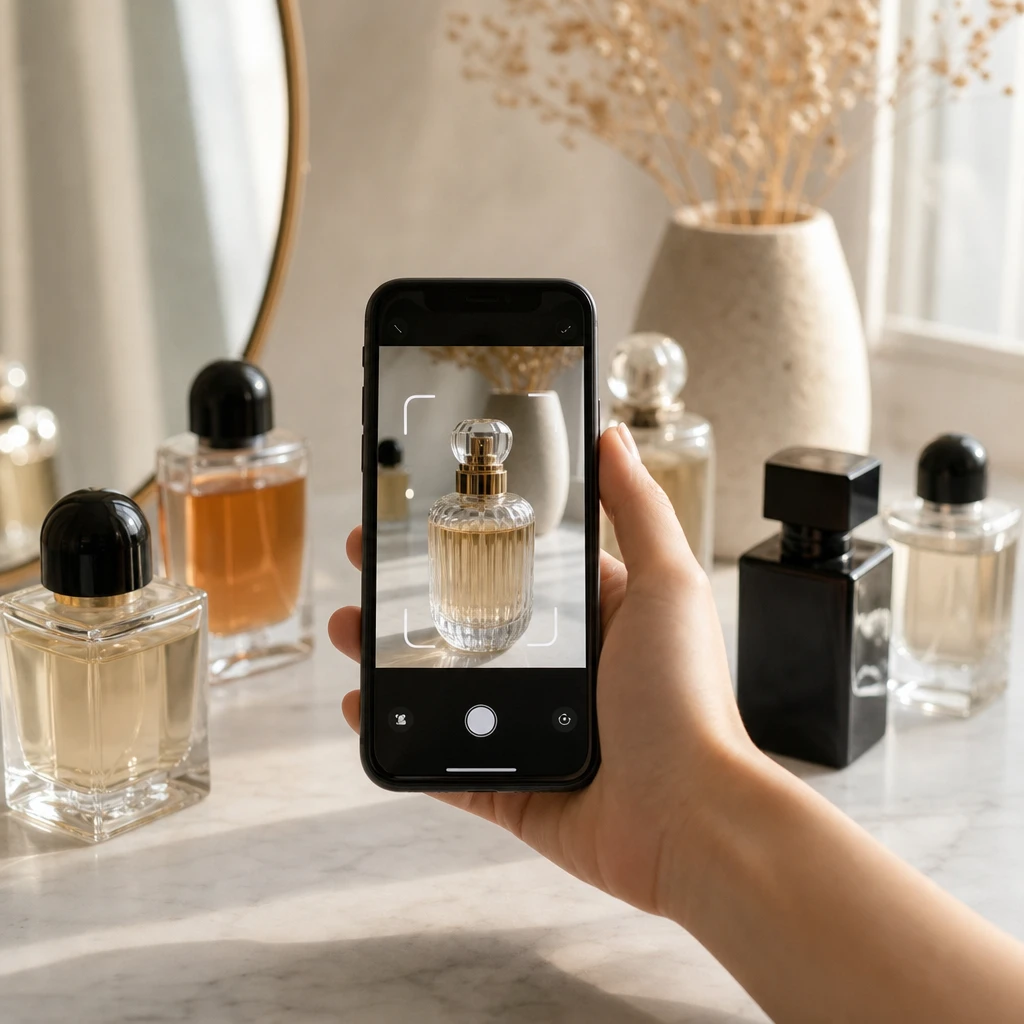
September 14, 2026
Identify This Perfume (2026): How Bottle Scanners Work—and How to Scan for Accurate Matches
September 14, 2026
Fragrance discovery has become more visual than ever. A bottle seen on a friend’s dresser, a blurred screenshot from social media, a half-used tester found in a drawer—those moments create a very specific kind of curiosity: not “recommend me something,” but “identify this exact perfume.”
That’s where a perfume bottle scanner earns its keep. Instead of starting with notes or brand names, scanning starts with what’s right in front of you: the bottle, the label, the box, or the barcode. When it works well, it turns a mystery bottle into a verified name you can research, sample, and—crucially—save to your collection.
At N.O.S.E. Notebook, we see bottle identification as the bridge between “I found something” and “I actually know what I own (or want).” The better the scan, the better the match.
Most fragrance identification app tools rely on one or more of these inputs:
1) Text recognition (OCR) from the label or box
If the brand name and fragrance name are readable, this can be extremely effective. The catch: many bottles use reflective glass, curved surfaces, or tiny print—hard conditions for OCR.
2) Barcode / UPC / EAN scanning
A barcode is often the most direct path to an exact product listing—when you have the retail box or a sticker with the code. With fragrance, this is common on packaging and less common on the bottle itself.
3) Image-based matching (visual similarity)
Some scanners use the bottle silhouette, cap shape, label layout, and color to narrow candidates. This can be helpful for popular designer bottles, but it gets tricky with niche packaging where many brands intentionally look minimal.
4) Community and database cross-references
Accuracy improves when a scanner can compare your scan against a robust catalog of releases, concentrations, and flankers (the “same name, different version” problem).
In practice, the best results come from scanning more than one element—especially when the bottle is older, the label is worn, or the fragrance is a niche release.
If you’ve ever scanned a bottle and gotten a “close but not quite” match, there’s a good reason. Fragrance lines often reuse names and bottle designs across:
A scanner may correctly identify the line but miss the exact version. That matters because performance, notes, and even the bottle details can change across versions.
The fix is simple: scan in a way that captures the version clues.
A great scan is mostly about lighting, angles, and choosing the right target (bottle vs box vs label). Here’s the approach that consistently improves match quality.
Start with the box if you have it. Packaging usually includes the clearest printed name plus a barcode/UPC.
If you’re scanning the bottle, do this:
Clean the glass (quickly)
Fingerprints and smudges can blur text and create glare. A microfiber cloth makes a noticeable difference.
Use soft, indirect light
Avoid harsh overhead lights and direct sun. A bright window beside you is ideal. This reduces glare on curved glass.
Tilt the bottle slightly, not the phone
Keeping the phone stable helps focus. Rotate the bottle until the label is readable and reflections fall away.
Fill the frame with the label
Scanners perform better when the brand and fragrance name occupy most of the image. Step closer rather than zooming digitally.
Capture multiple angles
If the first scan doesn’t land, grab:
Scan any sticker or fine print
Many bottles have small back labels or base stickers with concentration and size—details that separate near-identical matches.
If the app offers “add details,” include what you know (even partial info). A single extra clue—like “EDP” or “Intense”—can prevent a wrong match.
Worn labels are common on bottles that have lived in handbags, gym bags, bathrooms, or sunny windowsills. If you can’t read the front, you still have options.
Scan the bottom of the bottle. Some bottles have etched or printed identifiers, and even when they don’t, the base shape is a strong visual cue.
Scan the back label (if present). It may include the manufacturer, concentration, and distribution text.
Scan the atomizer and cap. It sounds minor, but cap geometry and sprayer style can distinguish lookalikes.
Scan the box (even if it’s dented). A torn box with a visible barcode is often better than a pristine bottle with no readable text.
And if all you have is a partial name—one word, a brand initial, or a recognizable logo—pair that with a clear bottle photo. Partial text + image tends to outperform image alone.
A lot of niche and luxury fragrance houses favor minimalist design: monochrome labels, small typography, similar bottle silhouettes across an entire line. That aesthetic is beautiful—and it can be tough for scanners.
To scan niche bottles more accurately:
If a scan returns several plausible options, treat it like a short list rather than a failure. Cross-check the concentration, bottle size, and naming (including accents and punctuation). Those small details matter.
In an ideal world, you’d scan both. But if you have to choose:
For collectors, the practical reality is: boxes get tossed, decants appear, and bottles travel. A strong bottle scan workflow is the difference between a clean catalog and a pile of “mystery sprayers.”
Identification is only half the win. The next step is making sure the answer doesn’t disappear into camera roll chaos.
Once the fragrance is identified, it helps to store it in a personal fragrance vault along with the details that matter in real life: where it came from, when you wore it, what it reminded you of, and whether you’d repurchase. That context becomes especially valuable when you’re comparing flankers, tracking samples, or trying to remember “the one that smelled amazing last winter.”
At N.O.S.E. Notebook, scanning is designed to flow into discovery and organization—so a single bottle ID can turn into a saved reference point for future recommendations.
A perfume bottle scanner can be the fastest route from “what perfume is this?” to a verified match—but accuracy depends on what you scan and how you capture it. Use soft light, avoid glare, take multiple angles, and scan the box or barcode when available. For worn labels and niche bottles, focus on capturing any remaining text and distinctive bottle features.
When you’re ready to turn one-off finds into a real collection—identified, organized, and easy to revisit—reach out to the N.O.S.E. Notebook team or explore the bottle scanning and fragrance vault tools online.
Find your next scent
Browse scent profiles, notes, and houses — or let the Scent Finder match you to a fragrance in four questions.

October 14, 2026
Perfume finder apps have leveled up fast: smarter AI, better bottle scans, and collection “vaults” that help you remember what you own (and what you actually love). Here’s what to look for in 2026—and how to choose the right app for your scent journey.

October 12, 2026
Finding a signature scent doesn’t have to mean buying a dozen discovery sets and hoping something clicks. Here’s a modern, realistic process—powered by a clear scent profile and smarter recommendations.

October 9, 2026
Trying to identify a perfume bottle from a photo? Here’s how perfume scanner apps work in 2026, how to scan bottles and labels for accurate matches, and how to fix the most common scan errors—especially when flankers and lookalike bottles confuse results.