
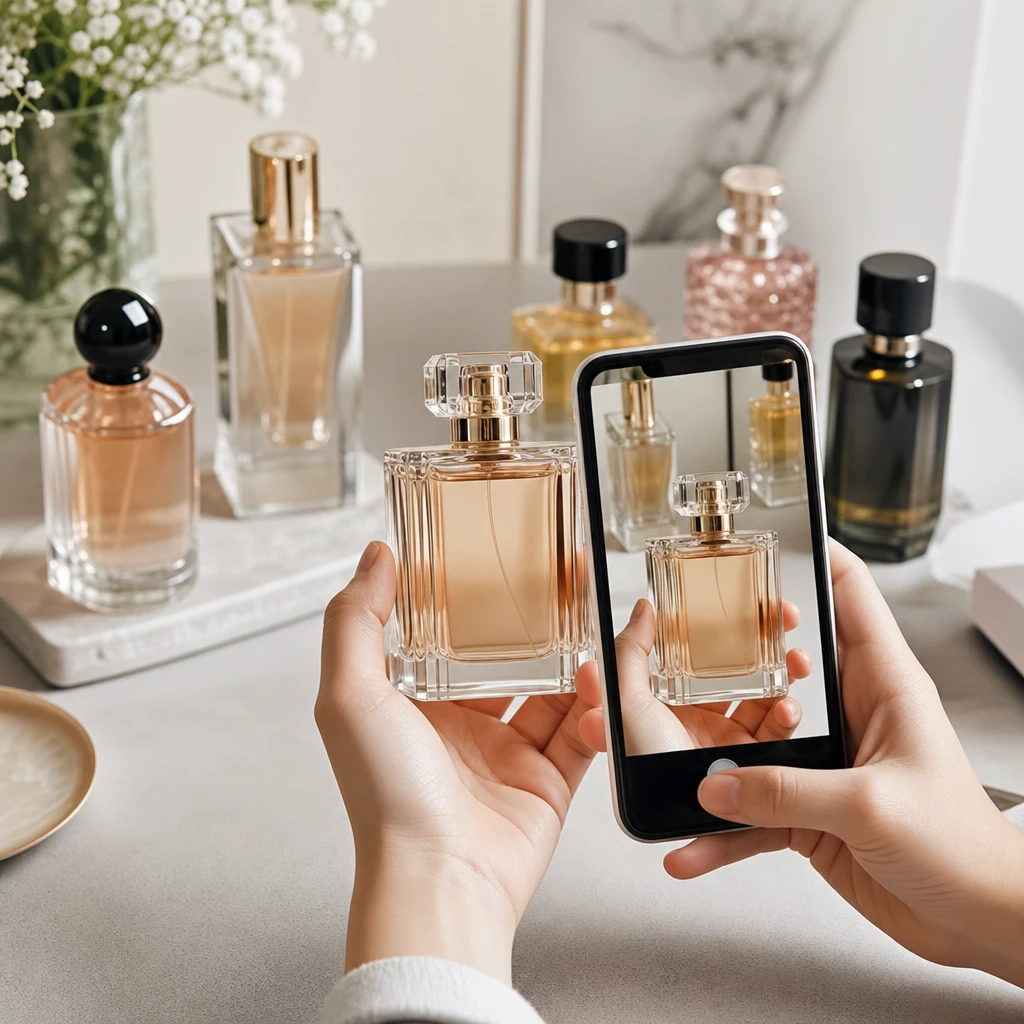
## Why perfume bottle scanning is having a moment (and what it’s actually good at)
If you’ve ever thought “what perfume is this?” while holding an unfamiliar bottle—or scrolling past a photo online—you’re not alone. In 2026, **perfume bottle scanning** has become a common feature in fragrance apps because it solves a real, high-friction problem: *identifying a scent you already have in your hand* so you can learn about it, log it, and find similar options.
Where bottle-scanning AI tends to perform best:
- **Popular designer releases** with widely photographed packaging
- **Current retail bottles** (clear branding, standard cap/bottle)
- **Straight-on photos** that show the label and silhouette
Where it still struggles:
- **Decants, travel sprays, and samples** (little to no identifying packaging)
- **Older bottles or reformulated packaging** (vintage vs. current)
- **Flankers** (same name line, slightly different bottle/color)
- **Limited editions and boutique releases** with fewer training images
- **Lookalike bottles** (many brands share similar silhouettes)
The key is to treat scanning as the first pass—then use a few quick checks to confirm the match.
## What you can (and can’t) identify from a picture
A lot of “identify fragrance from picture” searches assume the photo alone can reveal everything. In reality, identification is easiest when you can capture **both** brand markers and product-specific details.
**A scan can usually identify:**
- Brand + fragrance name (e.g., “Brand X – Signature”) when the label is visible
- Common variants (EDT vs EDP) if packaging clearly states it
- A near match (same line) even if it can’t nail the exact concentration
**A scan often can’t reliably identify:**
- Exact **batch or production year** (unless you provide batch code separately)
- A decant’s original fragrance (unless you add notes, seller info, or a label)
- The precise flanker (e.g., “Intense,” “Absolu,” “L’Elixir,” “Parfum”) if the photo doesn’t show the modifier
If you want the *exact* product listing, you’ll get better results by pairing the photo with one extra clue: the bottom sticker, box, or a readable line like “Eau de Parfum.”
## How to scan a perfume bottle for the most accurate ID
Small photo changes make a big difference. Here’s a simple checklist that improves accuracy across most perfume scanner tools.
### 1) Use bright, indirect light
Avoid harsh glare from flash—especially on glossy bottles. A window-lit shot (no direct sun) helps labels and embossing show up.
### 2) Clean the bottle (seriously)
Fingerprints blur tiny print and create reflections that confuse the scan. A quick wipe with a microfiber cloth can be the difference between “unknown” and a correct match.
### 3) Shoot straight-on, then add one angled shot
Take:
- **One front-facing photo** centered on the label
- **One 45° angle photo** to capture bottle shape and cap details
Cap shape, atomizer collar, and shoulder curves are often key identifiers.
### 4) Include the bottom sticker if you can
Many bottles have the most specific info underneath:
- concentration (EDT/EDP/Parfum)
- size (50 ml / 100 ml)
- sometimes a style number or internal code
Even if the app is focused on visual ID, this image is great for manual confirmation.
### 5) Don’t crop too tight
Leave a little background so the scanner can interpret the bottle outline. Over-cropping can remove shape cues.
### 6) If it’s a near-match, search within the “family”
When a scan returns something close (same brand/line), the right answer is often a **flanker**.
Common flanker clues to look for:
- different juice color
- different cap color
- a small word on the bottle (Intense, Sport, Absolu, Elixir)
- limited edition year markings
## The fastest way to confirm you’ve identified the right fragrance
Once scanning gives you a candidate, verify with two quick checks:
### Check A: Bottle + name details match
Compare:
- **logo placement**
- **font style**
- **cap and atomizer color**
- **label text** (especially tiny modifiers)
### Check B: Notes and “vibe” align with your memory
Even a perfect bottle match can mislead if you’re looking at a similarly packaged flanker. Skim the note pyramid and ask:
- Do I remember it being **fresh / sweet / woody / powdery**?
- Is there a standout (vanilla, iris, patchouli, ambroxan, citrus)?
If notes don’t align at all, you may have:
- the wrong flanker
- a counterfeit bottle
- a decanted scent in a reusable atomizer
## When scanning fails: 7 details that help an app (or a human) identify it
If the tool can’t identify your bottle from a picture, don’t give up. Add one or two of these details and try again.
1) **Where you got it** (department store, niche boutique, duty free, online)
2) **Approx. year** you bought it (packaging changes matter)
3) **Concentration** (EDT/EDP/Parfum/Extrait)
4) **Size** (30/50/100 ml) and whether it’s refillable
5) **Country text** on the bottom sticker (often helps narrow versions)
6) **A quick scent description** (3–5 words: “smoky vanilla,” “soapy musk,” “spicy amber”)
7) **What it reminds you of** (“similar to Baccarat Rouge style,” “like a clean laundry scent”)
Those extra clues are also what make AI recommendations dramatically better once you move from “ID” to “find me similar.”
## After identification: what to do with the result (so you don’t forget it again)
Identifying the perfume is step one. The real value is what you can do next:
### Build a personal “fragrance vault”
Save:
- the exact name and concentration
- when you wear it (work, date night, summer)
- your rating after 1 hour and after 6 hours
- compliments / memories / performance notes
Over time, your vault becomes a map of your taste—way more useful than trying to remember everything from a shelf.
### Create a simple scent profile from your own history
Once you’ve identified a few bottles you like (and a few you don’t), patterns show up quickly:
- Do you prefer **clean musks** or **sweet gourmands**?
- Are you drawn to **citrus aromatics** or **amber woods**?
- Do certain notes turn **sharp** on your skin?
That’s the foundation of truly personalized recommendations.
### Get “similar to this” recommendations that make sense
The best “more like this” suggestions use more than a note list. They also consider:
- intensity (skin scent vs loud)
- sweetness level
- texture (powdery, creamy, airy, syrupy)
- seasonality and occasion
If you tell an AI system *why* you like a fragrance (“creamy sandalwood but not too sweet”), you’ll get far fewer random results.
## Common questions about perfume bottle identifier tools
### Can AI identify perfume from just the bottle shape?
Sometimes, but shape alone is unreliable because many bottles share silhouettes. Label text, cap details, and bottom stickers improve accuracy.
### Can a scanner tell if a perfume is fake?
A scan can flag mismatched packaging (wrong font, wrong bottle for the name), but it can’t conclusively authenticate. For authenticity concerns, compare batch codes, packaging quality, sprayer construction, and retailer history.
### Will scanning work for minis and dabbers?
It can, but minis often vary by region and year, and labels are tiny. Use bright light and include a second image next to a coin for scale.
## A simple workflow that works every time
1) Take 2–3 photos (front, angle, bottom)
2) Run a bottle scan
3) Confirm with packaging details + notes
4) Save it to your vault with your personal wear notes
5) Ask for similar recommendations based on what you *actually* liked
If you’re building your collection—or just trying to keep track of what you’ve already tried—N.O.S.E. Notebook is designed for exactly this: **scan, identify, save, and discover what to wear next** at your own pace.
*If you want, try scanning one bottle you love and one you’re unsure about, then save both with a quick “why” note. That single habit makes future recommendations noticeably more accurate.*
Find your next scent
Explore the fragrance catalog
Browse scent profiles, notes, and houses — or let the Scent Finder match you to a fragrance in four questions.
More from Nose News
All articles →
October 14, 2026
Best Perfume Finder Apps in 2026: AI Recommendations, Bottle Scan, and Your Fragrance Vault
Perfume finder apps have leveled up fast: smarter AI, better bottle scans, and collection “vaults” that help you remember what you own (and what you actually love). Here’s what to look for in 2026—and how to choose the right app for your scent journey.
October 12, 2026
How to Find Your Signature Scent in 2026 (With an AI Scent Profile)
Finding a signature scent doesn’t have to mean buying a dozen discovery sets and hoping something clicks. Here’s a modern, realistic process—powered by a clear scent profile and smarter recommendations.
October 9, 2026
Perfume Scanner Apps (2026): How to Identify a Fragrance From a Photo + Fix Common Scan Errors
Trying to identify a perfume bottle from a photo? Here’s how perfume scanner apps work in 2026, how to scan bottles and labels for accurate matches, and how to fix the most common scan errors—especially when flankers and lookalike bottles confuse results.