
← Nose News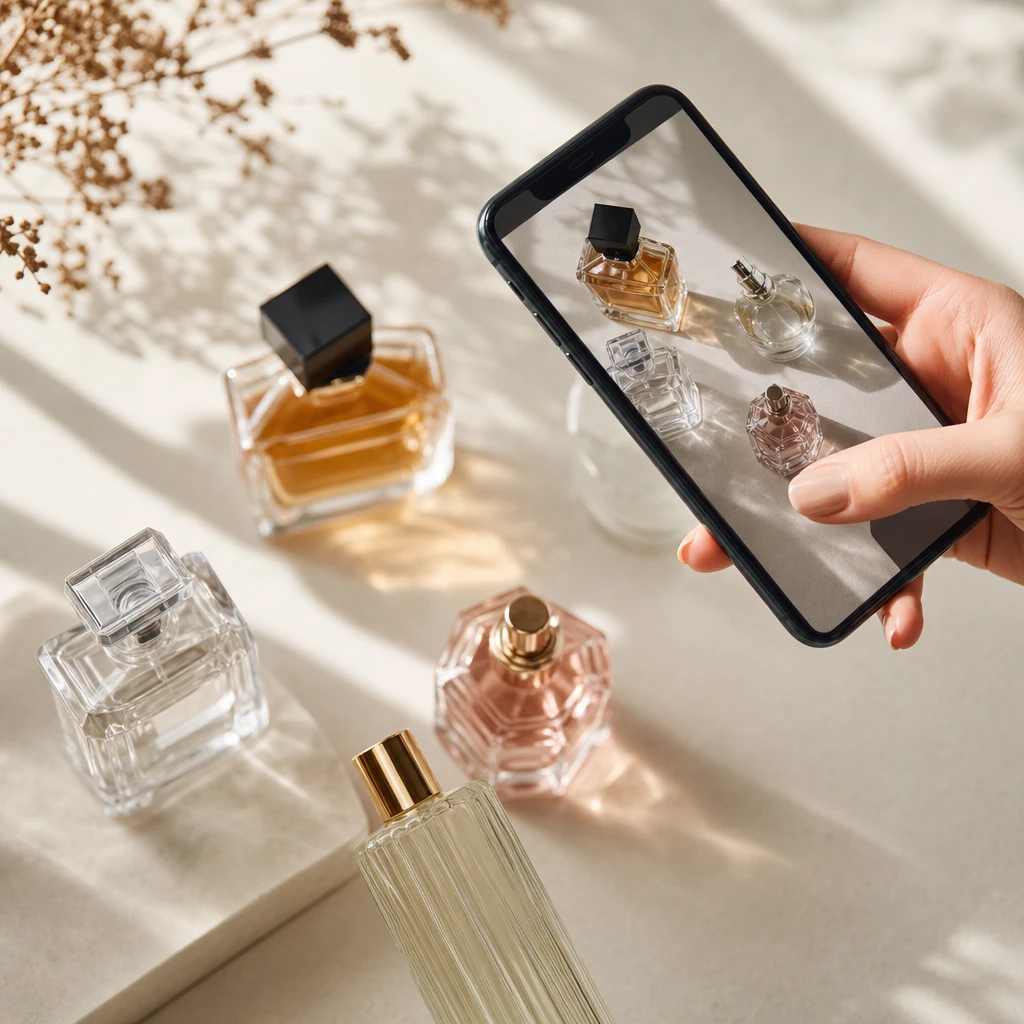
September 2, 2026
Perfume Scanner Apps (Fall 2026): How to Identify a Fragrance From a Bottle Photo
September 2, 2026
Perfume collecting looks different in 2026 than it did even a few years ago. Between discovery sets, travel sprays, subscription samples, and a booming secondhand market, it’s easy to end up with an “unlabeled mystery” on the shelf: a gift with the box tossed, a vintage mini, a decant with a handwritten sticker that’s rubbed off.
That’s exactly why perfume scanner apps and “what perfume is this?” bottle photo tools are trending. They’re fast, convenient, and—when conditions are right—shockingly accurate.
But there’s an important catch: a bottle photo isn’t a barcode. Many fragrances share similar silhouettes, and limited editions often reuse the same bottle with small label changes. Even the best systems can struggle when:
The goal isn’t perfection; it’s getting to a confident short list quickly, then confirming with a few extra details.
Below is a practical, real-world view of the tools people use most often for fragrance bottle identification.
| Tool | Best for | What it’s actually “seeing” | Strengths | Common misses |
|---|---|---|---|---|
| N.O.S.E. Notebook Bottle Scan | Fragrance-first identification and building your personal vault | Bottle + label cues, optimized for perfume context | Designed around perfume discovery and collection tracking; scan → identify → save | Very reflective bottles, extreme close-ups that crop key branding |
| Google Lens | Fast, broad internet matching | Visual similarity + web pages that look like your image | Quick, widely available, great when the bottle is popular and well-photographed online | Confuses flankers/limited editions; returns lookalikes, not the exact fragrance |
| Dedicated “barcode/beauty scanner” apps | Retail products with clear packaging | Often relies on barcode databases or product listings | Solid when a barcode is present and the item is current | Weak on vintage, decants, testers, or anything without a scannable code |
If the goal is simply “find anything close,” general visual search can work. If the goal is “identify this exact perfume and remember it later,” a fragrance-first workflow (scan + save to a vault) tends to fit how collectors and curious newcomers actually behave.
Bottle recognition works best when it’s treated like a quick investigation rather than a single magic tap.
Start with a clean bottle photo scan. Capture the front label and the cap shape.
Confirm the brand + line name. Many bottles clearly show the brand (even if the fragrance name is small). If the scan returns multiple matches, narrow by brand first.
Check concentration cues. If the bottle says Eau de Parfum, Eau de Toilette, Parfum, or Extrait, note it. Concentration is often the difference between two near-identical listings.
Validate with one “secondary proof.” Use any one of these:
Save it immediately. Once identified, add it to a personal fragrance vault so the mystery doesn’t return the next time you reorganize your shelf.
Small changes in photography make a big difference in perfume bottle recognition. Use this quick checklist before you rescan.
If a scan keeps returning “close but not quite,” it’s usually not the tool—it’s the inputs: glare, cropping, or a bottle style that’s shared across multiple releases.
Seeing three to ten plausible results is normal, especially for popular lines with lots of flankers. Here’s how to pick the right one quickly.
First, look for the exact wording on the label. “Intense,” “L’Elixir,” “Absolu,” “Noir,” “Nuit,” and seasonal editions are common points of confusion.
Next, compare the cap and atomizer. Brands frequently reuse the bottle but change the cap finish (matte vs. glossy) or add a plaque.
Then, check the year or batch code if available. Collectors sometimes use batch codes to estimate production timeframe; even without decoding it, the presence and placement can help you match the right listing.
Finally, if you’re still torn, treat the scan result as a starting point: confirm with a quick label close-up photo and a second angle (3/4 view) to help lock in the ID.
Once a fragrance is identified, the real value comes from what happens next. A scan becomes the entry point to a personal system:
For newcomers, this prevents the common spiral of buying what’s trending and wondering why nothing feels like “you.” For collectors, it reduces duplicates and makes your wardrobe easier to rotate.
Can I identify perfume by photo if the label is missing?
Sometimes—but expect lower confidence. Bottle shape alone is often shared across multiple fragrances. Try photographing the cap, atomizer, and any embossed logos, plus the bottom of the bottle.
Do these apps work on vintage bottles?
They can, but vintage is hit-or-miss. Older packaging, reformulations, and limited online imagery make identification harder. Clean lighting and multiple angles help.
What about decants and samples?
If the original bottle isn’t present, a scanner can’t reliably identify it from a generic vial. In that case, the best path is logging the name once you learn it, then keeping it in a fragrance vault for future reference.
Is Google Lens good enough for “what perfume is this bottle?”
For popular releases with lots of online photos, yes—often. The tradeoff is that Lens is designed for broad visual matching, not perfume-specific edge cases like flankers, seasonal editions, and near-identical bottles.
In Fall 2026, identifying a fragrance from a bottle photo is easier than ever—but accuracy still depends on the photo, the packaging, and how distinctive the bottle is. The most reliable approach is a simple one: scan with a clear, glare-free image, confirm with one extra detail, and save the result so it stays identified.
At N.O.S.E. Notebook, we built bottle scanning around what happens after the match—discovering similar scents, organizing what you own, and turning random finds into a collection you actually understand. When you’re ready, reach out to the team or explore N.O.S.E. Notebook online to start scanning and building your fragrance vault.
Find your next scent
Browse scent profiles, notes, and houses — or let the Scent Finder match you to a fragrance in four questions.

October 14, 2026
Perfume finder apps have leveled up fast: smarter AI, better bottle scans, and collection “vaults” that help you remember what you own (and what you actually love). Here’s what to look for in 2026—and how to choose the right app for your scent journey.

October 12, 2026
Finding a signature scent doesn’t have to mean buying a dozen discovery sets and hoping something clicks. Here’s a modern, realistic process—powered by a clear scent profile and smarter recommendations.

October 9, 2026
Trying to identify a perfume bottle from a photo? Here’s how perfume scanner apps work in 2026, how to scan bottles and labels for accurate matches, and how to fix the most common scan errors—especially when flankers and lookalike bottles confuse results.