
← Nose News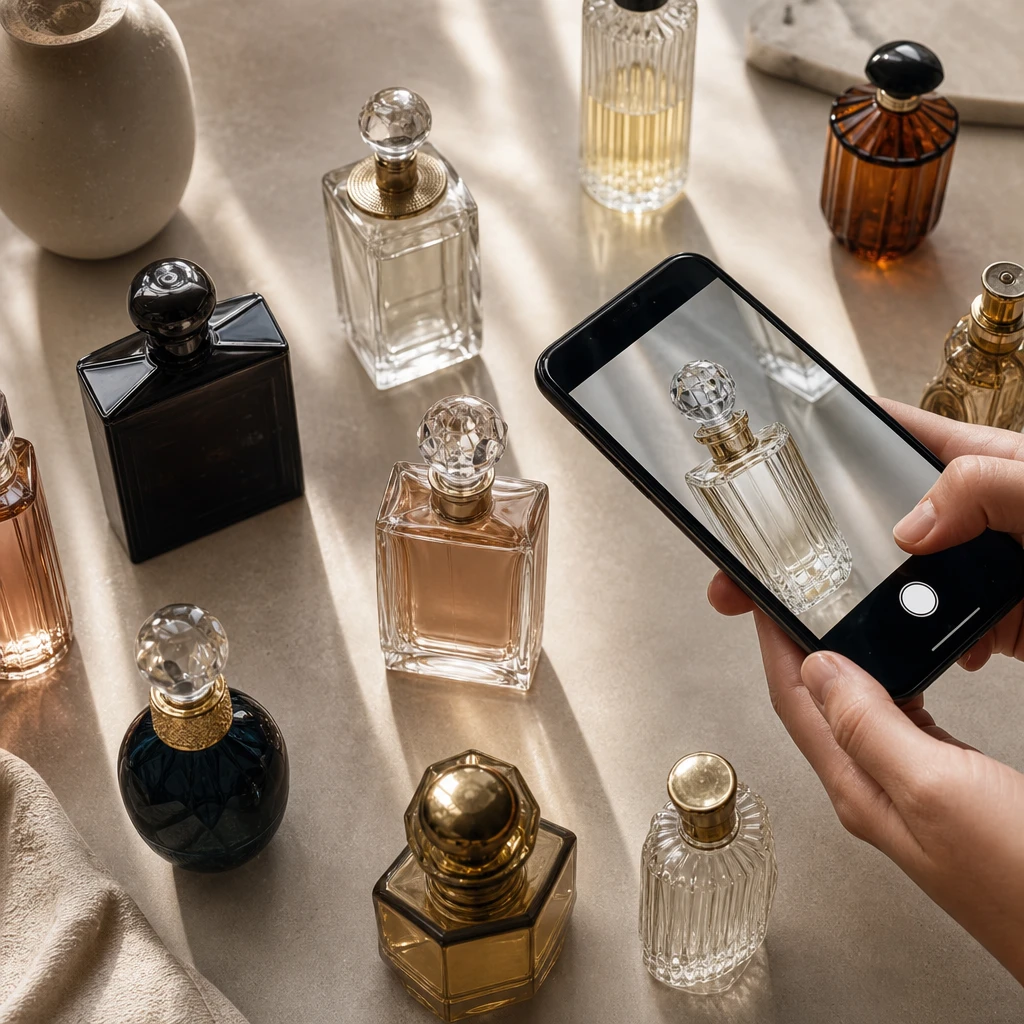
July 27, 2026
Identify This Perfume Bottle (2026 Update): How Bottle Scanning Works, What to Do When It Fails, and How to Catalog Your Finds
July 27, 2026
If a fragrance is already sitting on a dresser, in a bathroom cabinet, or in a thrifted gift set, the motivation is real: someone wants an answer now. Sometimes it’s nostalgia (“What did my aunt wear?”). Sometimes it’s practicality (“I love this—what is it so I can repurchase?”). And sometimes it’s pure curiosity after spotting a bottle at a friend’s place.
In 2026, bottle-scan tools and perfume databases are better than ever, but the best results still depend on the photo, the details captured, and knowing what to check when the first match isn’t correct.
At N.O.S.E. Notebook, we focus on turning that moment of curiosity into a useful record: identify the bottle, confirm the exact version, then save it to a personal fragrance vault so it doesn’t become another mystery later.
Most “perfume bottle identifier” tools rely on a combination of:
A scan is rarely “magic.” It’s pattern recognition. The more clearly the camera captures unique elements—cap shape, embossing, bottle geometry, and exact wording—the more accurate the identification.
When identification fails, it’s usually because the photo isn’t giving the system enough reliable information. These quick adjustments dramatically improve results.
The bottom sticker often includes the full product name, concentration, size, and a batch code. That’s critical when multiple versions exist.
Recommended set:
Glossy glass creates reflections that confuse label recognition.
A tiny bottle in the middle of a wide shot forces the system to guess.
Caps are often the “fingerprint” of a release—especially in luxury and niche lines.
Not every bottle is straightforward. Here are the scenarios we see most often—and the checks that resolve them.
If the bottle is empty, identification relies heavily on shape and hardware.
What helps:
If the scan returns multiple close matches, the fastest tiebreakers are usually the cap design and any etched or embossed glass details.
A decant is typically unidentifiable by bottle alone because the container is generic.
Best approach:
Miniatures often omit concentration or have simplified branding.
Tips:
Many brands release flankers that keep the same bottle shape but change color or a small line of text.
What to check:
This is where “identify perfume by bottle” can be deceptively hard: a scan may correctly identify the line, but not the exact flanker.
Some fragrances change bottle details across years, or release seasonal limited packaging.
Best practice:
Once a scanner suggests an identity, confirm these details before repurchasing:
This avoids the common frustration of ordering what looks right online and discovering it’s a different concentration—or a flanker that wears nothing like the original.
A lot of perfumes are discovered the same way: a gift, a hand-me-down, a sample set, a bottle spotted while traveling. Identification solves the immediate mystery, but the value compounds when the find becomes searchable later.
A well-kept fragrance vault typically includes:
This creates a personal reference library—especially useful for enthusiasts who rotate scents and want to avoid accidental duplicate purchases.
When a “perfume bottle lookup” returns the wrong fragrance—or nothing at all—these are the usual culprits:
Even with the best tools, the last 10% is often human verification: matching the exact name and concentration printed on the bottle.
Our goal is to make fragrance discovery easier and more organized—not just to provide a single answer and move on. Bottle scanning is the perfect entry point because it starts with a real object in hand.
Once a bottle is identified, the next step is capturing it in a personal scent profile and vault so it can be:
That’s how “what perfume is this?” becomes a smarter fragrance journey—especially for anyone exploring niche, designer, and luxury perfume with intention.
Perfume bottle identification is much more accurate in 2026 than it was even a few years ago, but the best results still come down to the basics: clear photos, multiple angles, and careful confirmation of flankers and concentrations. When the match is correct, saving it to a fragrance vault ensures the discovery doesn’t get lost again.
For anyone building a more organized fragrance life—whether it’s a growing collection or a handful of beloved staples—N.O.S.E. Notebook is built for scanning, identifying, and keeping every scent story in one place. Reach out to the team or visit N.O.S.E. Notebook online to start cataloging what’s already on the shelf.
Find your next scent
Browse scent profiles, notes, and houses — or let the Scent Finder match you to a fragrance in four questions.
October 14, 2026
Perfume finder apps have leveled up fast: smarter AI, better bottle scans, and collection “vaults” that help you remember what you own (and what you actually love). Here’s what to look for in 2026—and how to choose the right app for your scent journey.
October 12, 2026
Finding a signature scent doesn’t have to mean buying a dozen discovery sets and hoping something clicks. Here’s a modern, realistic process—powered by a clear scent profile and smarter recommendations.
October 9, 2026
Trying to identify a perfume bottle from a photo? Here’s how perfume scanner apps work in 2026, how to scan bottles and labels for accurate matches, and how to fix the most common scan errors—especially when flankers and lookalike bottles confuse results.