
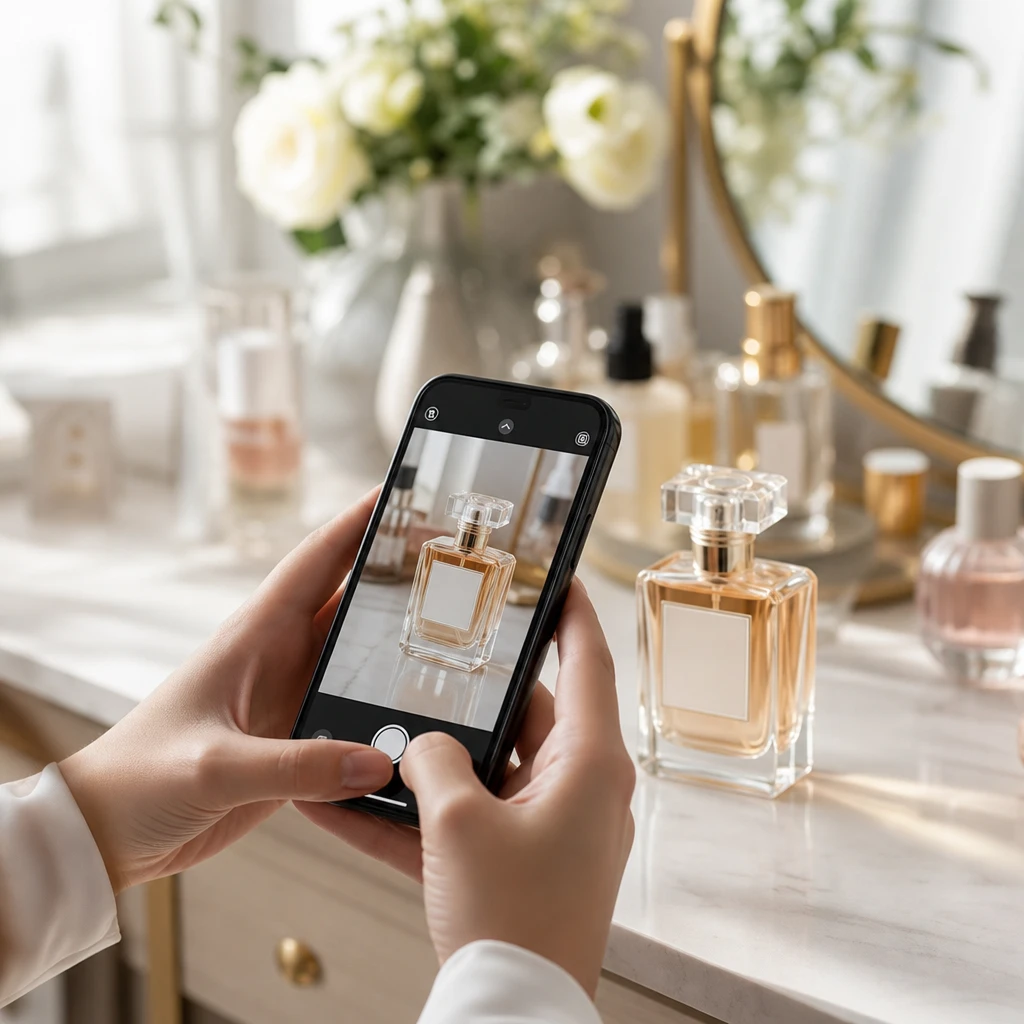
Why “identify perfume by photo” searches are exploding in 2026
Perfume discovery has gone visual. A bottle flashes across a TikTok, a friend pulls something beautiful out of a bag, or a travel-size shows up as a gift with a rubbed-off label—and suddenly the mission is on: find that exact fragrance.
At the same time, camera-based recognition and label-reading (OCR) have become normal in everyday life, so it makes sense that people expect a “perfume bottle scanner” experience to work just as smoothly. Some tools do, some don’t—and the difference often comes down to the photo you have and the clues you know to look for.
We built this guide for anyone trying to do perfume bottle identification from a picture: enthusiasts cataloging a growing collection, newcomers who don’t know where to start, and anyone who’s tired of losing track of the scents they sample.
Start with the simplest win: capture the right photo (or screenshots)
If you can retake the photo, it’s worth doing. Identification is much easier when the bottle is photographed like a product shot—not like a mood shot.
Aim for:
- Front label, straight-on, filling most of the frame
- Cap visible (caps are surprisingly brand-specific)
- Bottom of the bottle (often includes batch codes, size, concentration)
- Box or card if you have it—many are easier to ID than the bottle
Even if the label is hard to read, a sharp image gives OCR tools a fighting chance and helps you (or an app) distinguish between near-identical flankers.
Bottle-shape clues that narrow the field fast
When you’re trying to identify perfume by picture, don’t think “pretty bottle.” Think: manufacturing cues and design signatures.
1) The silhouette
Some houses repeat a core bottle shape for years and release many variants in it. If the silhouette matches, you may only be choosing among editions.
2) Cap geometry and material
Caps are often the giveaway: heavy metal, magnetic closure, a specific monogram, an asymmetrical shape, or a distinctive sprayer collar.
3) Atomizer style
Is it a standard crimped atomizer with a collar? A hidden sprayer? A decorative plate? Many niche brands use recognizable hardware.
4) Color and transparency
Tinted glass, gradient paint, opaque lacquer, or a fully clear bottle—these details can separate a “brand family” from a specific release.
5) Label placement and typography
Even when text is unreadable, layout matters: centered plaque vs. corner label, raised emblem, serif vs. sans-serif, and spacing. Typography can be as identifying as a logo.
The key is to translate what you see into searchable descriptors: “square clear bottle gold round cap,” “black lacquer bottle rectangular label,” “tall cylinder frosted glass.” Those phrases work well alongside OCR.
Read the label like a perfumer (and a retailer)
Most people focus on the big name and miss the small print that actually pinpoints the product.
Look for:
Concentration: Eau de Parfum, Eau de Toilette, Parfum, Extrait, Cologne, Elixir. The same fragrance name may exist in multiple concentrations with different bottles.
Size: 30 ml / 50 ml / 100 ml (or fl oz). Sizes help confirm you’ve found the correct listing.
Brand vs. line vs. scent name: Sometimes the largest word is the brand, sometimes it’s the collection. Identifying the hierarchy prevents wrong matches.
Language variants: A label may show “Vaporisateur / Natural Spray,” “Eau de Parfum,” or “Made in…” which can hint at region and distribution.
If you have the box, check for:
- Barcode (UPC/EAN)
- Batch/lot code
- Full ingredient list (useful for cross-checking)
Using OCR and “perfume bottle scanner” tools: what they do well (and where they fail)
Fragrance identification tools typically rely on two signals:
- Image recognition (matching bottle shape/label layout against a database)
- OCR (reading label text and searching it)
In practice, OCR is often the more reliable of the two when the label is legible—even partially. Image recognition helps when the bottle is iconic, but it struggles with:
- Reflections on glass
- Low-contrast labels (tone-on-tone)
- Limited edition bottles
- Travel sizes and minis that differ from full-size packaging
A useful workflow in 2026 is hybrid: use OCR to pull whatever text you can, then use the bottle’s shape and cap details to validate the match.
One caution: many “identifier” tools will confidently return a result even when the image is ambiguous. Treat early results as candidates, not conclusions.
The verification step most people skip: batch codes and retailer cross-checks
If you want to be sure you’ve identified the right perfume, verify with at least one hard detail.
Batch/lot codes
Batch codes are usually printed or etched on the bottle bottom and/or box. They’re primarily for production tracking, but they can confirm you’re looking at the right brand family and packaging format.
Retailer imagery
Once you think you’ve found it, cross-check against multiple official or reputable retailer photos. Look for exact matches in:
- Cap shape and finish
- Label placement and borders
- Bottle tint and thickness
- The way the brand name is printed (spacing matters)
This step is especially important for popular scents with many flankers (seasonal editions, “Intense,” “Absolu,” “Elixir,” etc.). Two bottles can look similar but wear very different.
Common “gotchas” that derail perfume bottle identification
A few patterns show up again and again:
You’re seeing a decant or refillable travel spray.
Decants often have generic atomizers and labels. If the bottle looks plain but the label seems like it was printed at home, you may need to identify the scent name from the text rather than the bottle.
The bottle is from a discovery set.
Minis and samples can have simplified branding, smaller caps, or no cap at all.
It’s a flanker, not the original.
Same shape, different colorway. If OCR only catches the main name, you might miss “Intense,” “L’Eau,” or a year-limited release.
The label is a sticker placed by a boutique.
Some shops add their own sticker with price or inventory codes that hide the important text.
When identification feels “almost right,” it usually means one of these gotchas is in play.
The best way to never lose a mystery fragrance again: scan and save it
Identification is only half the job. The real win is turning a one-time guess into a lasting record—especially if you love sampling, visiting perfume counters, or collecting discovery sets.
At N.O.S.E. Notebook, we focus on the full loop:
- Fragrance bottle scanning & identification to help connect a photo to a likely match
- A personal scent profile that learns what you actually enjoy (and what you don’t)
- A fragrance vault to save the perfumes you own, the ones you’ve tested, and the ones you plan to sample
That vault matters because “the one you smelled in April” becomes impossible to track by memory alone. Saving the bottle, the name, and your impressions (even a quick note like “soft musky drydown, loved on sweater”) turns casual discovery into a curated wardrobe.
A quick, reliable identification checklist
When you’re trying to find a perfume by bottle, run through this sequence:
- Capture front label + cap + bottom (or grab multiple screenshots)
- Use OCR to extract any readable text
- Search using brand + one unique word + “eau de parfum” (or the concentration you see)
- Confirm with packaging details against reputable retailer photos
- If available, check batch/lot code on box or bottle
- Save the result in your fragrance vault so the search ends for good
Conclusion
Perfume bottle identification has gotten dramatically easier as camera tools and OCR have improved—but the best results still come from using the right clues in the right order: clear photos, label details, and a quick verification step before you commit to a match.
If there’s a bottle in your camera roll that’s been driving you nuts, N.O.S.E. Notebook is built for exactly that moment—scan, identify, and save your discovery so it’s part of your scent story, not a forgotten screenshot.
Find your next scent
Explore the fragrance catalog
Browse scent profiles, notes, and houses — or let the Scent Finder match you to a fragrance in four questions.
More from Nose News
All articles →
October 14, 2026
Best Perfume Finder Apps in 2026: AI Recommendations, Bottle Scan, and Your Fragrance Vault
Perfume finder apps have leveled up fast: smarter AI, better bottle scans, and collection “vaults” that help you remember what you own (and what you actually love). Here’s what to look for in 2026—and how to choose the right app for your scent journey.

October 12, 2026
How to Find Your Signature Scent in 2026 (With an AI Scent Profile)
Finding a signature scent doesn’t have to mean buying a dozen discovery sets and hoping something clicks. Here’s a modern, realistic process—powered by a clear scent profile and smarter recommendations.

October 9, 2026
Perfume Scanner Apps (2026): How to Identify a Fragrance From a Photo + Fix Common Scan Errors
Trying to identify a perfume bottle from a photo? Here’s how perfume scanner apps work in 2026, how to scan bottles and labels for accurate matches, and how to fix the most common scan errors—especially when flankers and lookalike bottles confuse results.