
← Nose News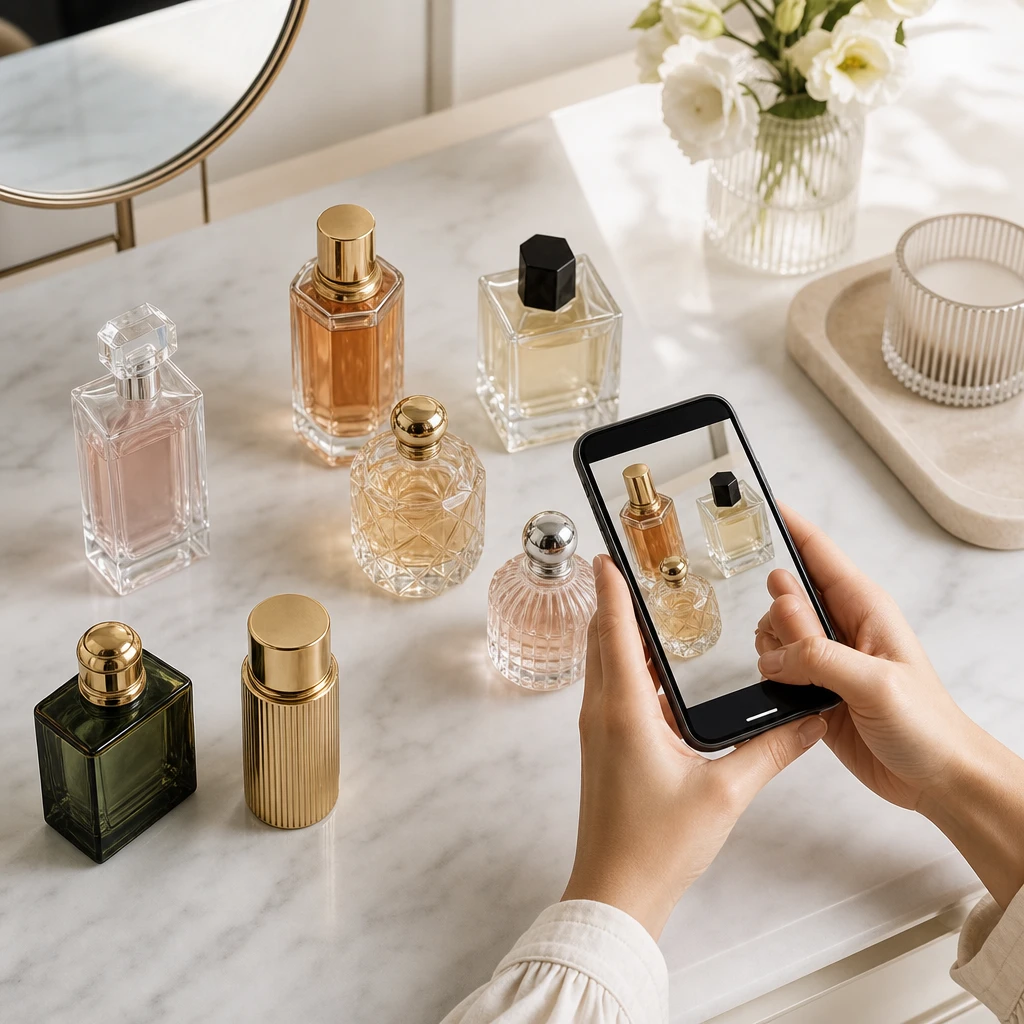
September 16, 2026
How to Identify a Perfume From a Photo: Bottle-Scanning Tips (and What to Do When the Scan Fails)
September 16, 2026
Perfume collecting has changed. People swap decants, shop resale, discover minis in travel sets, inherit bottles, and save screenshots from social media. That’s great for discovery—but it also creates a very modern problem: a beautiful bottle with no box, no receipt, and no clear name.
Searching “what perfume is this” or “identify perfume by bottle” is often the fastest path back to the fragrance—especially when you’re trying to re-buy, compare batches, or simply log what you own. Bottle scanning and photo-based identification can work remarkably well, but results depend heavily on the image you provide and the clues you capture.
Below is a practical, field-tested approach we use at N.O.S.E. Notebook to help people identify fragrances quickly, then organize what they find inside a personal fragrance vault for future recommendations and discovery.
A scanner can only match what it can “see.” Most failed scans happen because the bottle details that matter—logo, label text, cap shape, plaque placement—are washed out, hidden by glare, or blurred.
Here’s how to set up a scan-friendly photo in under two minutes:
If you can take more than one image, do it. Multiple angles dramatically improve identification—especially for bottles with minimal branding.
When someone says “I tried scanning and it didn’t work,” it’s usually because the photo didn’t capture the identifying features. For most fragrances, these four shots cover what scanners and databases need:
Front-on, label readable (straight, not angled)
Back of bottle (many have tiny printed text, concentration, or a distributor line)
Bottom of bottle (batch code, sticker, or etched glass often lives here)
Cap and sprayer close-up (cap shape and atomizer design are surprisingly distinctive)
If the bottle is clear and the juice is tinted, also take a quick photo against a neutral background—color can be a helpful secondary clue.
Photo identification is powerful, but pairing it with a few quick details can make the difference between a near miss and a perfect match.
Before you rescan or start searching, check for:
Even if you don’t recognize the brand, capturing these details helps identification tools and reduces false matches.
Even with a great photo, there are legitimate reasons a perfume identifier app or scanner might not return a confident result:
Limited database coverage. The fragrance world is huge: discontinued releases, flankers, regional exclusives, and boutique lines can slip through.
Reformulations and repackaging. A scent may keep the name but change bottle design over time—or the reverse.
Lookalike bottles. Many bottles share similar shapes (simple rectangles, round “apothecary” styles), especially for private-label or dupe brands.
Decants and travel sprays. If the scent is in an unbranded atomizer, photo ID can’t work. In that case, you’ll need the name from the seller, the original bottle, or the notes.
When identification doesn’t happen on the first try, the goal is to move from “no match” to “fewer possibilities,” then to a confident ID.
Glass is reflective. If you see bright hotspots, rotate the bottle a few degrees and move your light source to the side. A window at a 45° angle is often perfect.
Batch codes and tiny stickers can be hard to read in real life but clear when zoomed in on a high-resolution photo. That code can confirm a match once you’ve narrowed candidates.
If you can make out even partial text (two or three letters), combine it with visual descriptors:
This isn’t as elegant as scanning, but it’s effective—especially for designer bottles.
If you can’t identify by bottle, shift to identifying by what you smell. Write down 5–10 concrete impressions:
At N.O.S.E. Notebook, this is where AI fragrance recommendations become especially useful: once you describe the scent and the kind of wear you want, it’s often possible to surface likely matches—or at least a tight shortlist of similar fragrances worth comparing.
Many popular perfumes spawn flankers with nearly identical bottles and slightly different colorways. If your scan keeps returning “close, but not quite,” you may be holding a flanker.
Look for tiny differentiators: a different plaque color, a seasonal name line, a subtle band around the neck, or a slightly altered cap.
Identification is only half the win. The real payoff comes when you can catalog what you own and what you’ve tried—so every future recommendation gets smarter.
A simple, reliable approach is to log:
Inside N.O.S.E. Notebook, that information becomes a living scent profile and a personal fragrance vault—so when you scan a bottle you discovered, it doesn’t disappear into camera roll chaos. It becomes part of a collection you can search, compare, and build on.
Some situations come up constantly, so it helps to know the best route right away.
You have a full bottle but no box. Start with front + base photos. Most of the time, the base sticker or etched code is the key.
You have a mini/travel size with minimal branding. Photograph the atomizer and cap, then search by partial text plus bottle style. Minis often omit details that the full bottle includes.
You have a decant in a generic spray. Photo ID won’t work. Your best option is seller info, then confirm by comparing notes/similar fragrances.
You have a screenshot from social media. Crop to include the full silhouette and cap. If the label is unreadable, use the shape and cap as primary identifiers.
Identifying a perfume from a photo is absolutely possible, but it’s not magic: clarity, angles, and the right details matter. When scanning works, it’s the quickest path from “mystery bottle” to a confirmed fragrance. When it doesn’t, switching to base codes, descriptor searches, and note-based matching usually gets you back on track.
For fragrance lovers building a collection over time, the next step is keeping those finds organized. N.O.S.E. Notebook brings bottle scanning, identification, and personalized discovery together—so the scents you find today can power smarter recommendations tomorrow. If you’re ready to turn sporadic discoveries into a searchable, growing fragrance wardrobe, reach out to the N.O.S.E. Notebook team and start building your vault.
Find your next scent
Browse scent profiles, notes, and houses — or let the Scent Finder match you to a fragrance in four questions.

October 14, 2026
Perfume finder apps have leveled up fast: smarter AI, better bottle scans, and collection “vaults” that help you remember what you own (and what you actually love). Here’s what to look for in 2026—and how to choose the right app for your scent journey.

October 12, 2026
Finding a signature scent doesn’t have to mean buying a dozen discovery sets and hoping something clicks. Here’s a modern, realistic process—powered by a clear scent profile and smarter recommendations.

October 9, 2026
Trying to identify a perfume bottle from a photo? Here’s how perfume scanner apps work in 2026, how to scan bottles and labels for accurate matches, and how to fix the most common scan errors—especially when flankers and lookalike bottles confuse results.