
← Nose News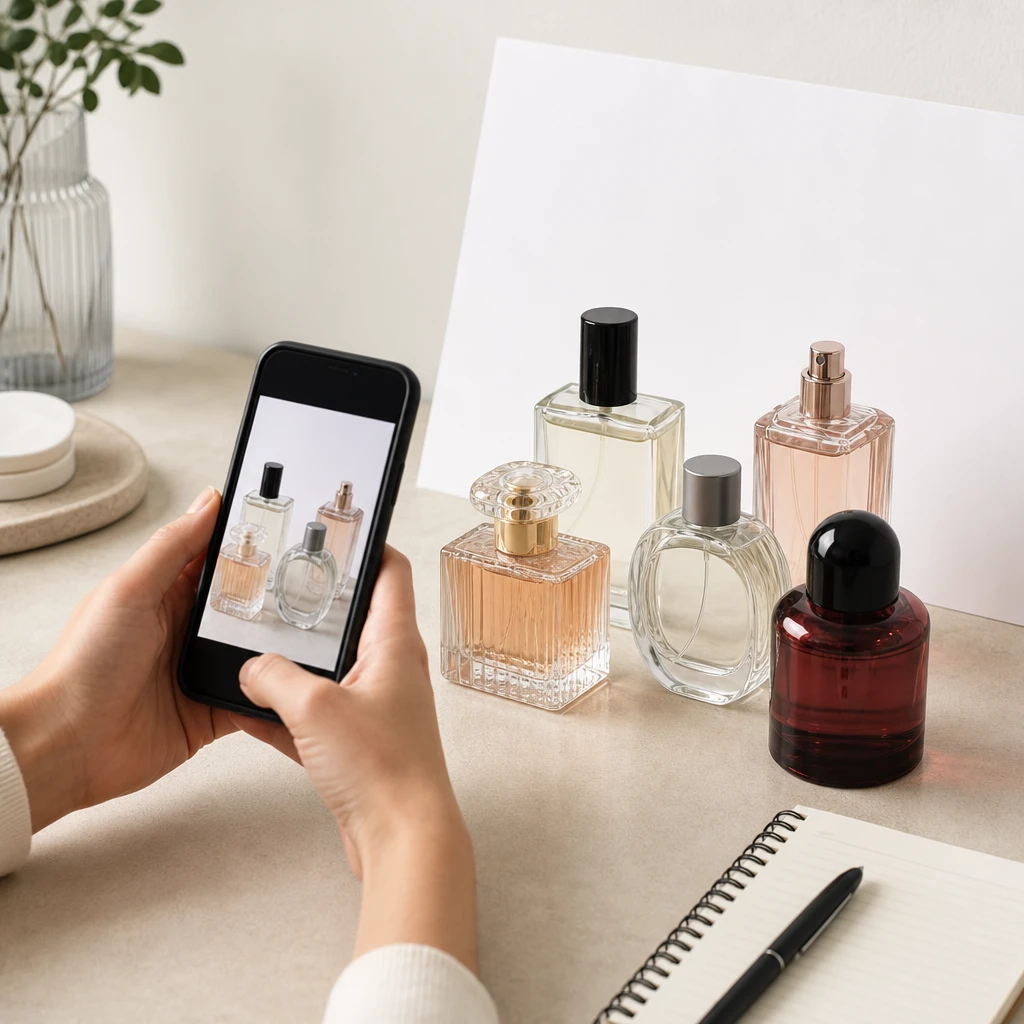
July 24, 2026
Identify This Perfume (2026 Update): How to Scan a Bottle, Decode Batch Codes, and Avoid Common ID Mistakes
July 24, 2026
Perfume ID used to be as simple as recognizing a famous silhouette. Today, it’s trickier for a few reasons:
At N.O.S.E. Notebook, we see the same bottlenecks again and again. This guide lays out a reliable, repeatable process to identify a perfume bottle from a picture, reduce false matches, and document what you found in a way that stays useful later.
A fragrance bottle scanner is only as good as the inputs. Before attempting a scan, treat it like photographing jewelry: lighting and angles matter.
For best results, capture:
This trio solves most misidentifications—especially when multiple flankers share similar glass.
Glare hides lettering and makes glass look like a blank shape.
If the label is metallic, take one photo straight-on and one with a slight angle; scanners often “catch” the text better in the angled version.
A plain background helps. If the bottle is transparent, place it against a solid dark surface to make the edges and internal dip tube visible—useful for differentiating similar silhouettes.
Even a great perfume bottle identifier will sometimes return “no match” or a wrong match. Here are the most common culprits.
Brands frequently reuse the same bottle mold across multiple versions. The difference may be one word (“Intense,” “Absolu,” “Parfum”) or a subtle color shift.
What to check:
Pro tip: When a scan returns an answer, confirm it by matching concentration + size + bottle details instead of relying on name alone.
A lot of people photograph the wrong number. Bottles and boxes can include:
What to do:
Batch codes are useful for verifying production details and narrowing down versions when packaging changed over time. They are not a perfect “authenticity guarantee,” but they can help you spot inconsistencies.
If you’re working from a decant label like “BR540 Extrait” or “Santal,” you’re missing the data scanners love.
What to capture instead:
If the label is handwritten or abbreviated, add your own notes in your fragrance vault so you don’t lose the breadcrumb trail.
Minis often omit details present on full-size bottles, and some are designed for dab application (no sprayer). If the scan struggles:
“Perfume batch code lookup” searches are popular because people want certainty: age, version, legitimacy.
Batch codes can help you:
Batch codes cannot reliably:
The best practice is to treat a batch code as one signal alongside bottle construction, print quality, sprayer hardware, and purchase source.
Counterfeit spotting is a deep topic, but a few high-signal checks help avoid false alarms.
If the bottle looks convincing but the price and source don’t align with the brand’s normal retail landscape, treat that as a major signal. Authentication is about pattern recognition across multiple details, not one smoking gun.
When someone wants to identify a cologne bottle or track a perfume found at a friend’s house, this sequence is fast and accurate:
That last step is where identification becomes genuinely useful. A name alone doesn’t help much six months later—your notes do.
A strong catalog entry prevents repeat detective work and improves future recommendations.
Include:
At N.O.S.E. Notebook, we structure this kind of data into a personal scent profile and vault—so each identification also sharpens future fragrance recommendations.
Identifying a perfume from a picture is absolutely doable in 2026, but accuracy depends on clear photos, smart troubleshooting for glare and flankers, and using batch codes as a supporting clue—not the only proof. Once the match is confirmed, logging it properly turns a one-time discovery into a lasting reference for collecting, re-buying, and finding similar scents. For those building a fragrance wardrobe online, N.O.S.E. Notebook makes it easy to scan, identify, and keep every find organized in one place—then use that history to power better recommendations.
Find your next scent
Browse scent profiles, notes, and houses — or let the Scent Finder match you to a fragrance in four questions.
October 14, 2026
Perfume finder apps have leveled up fast: smarter AI, better bottle scans, and collection “vaults” that help you remember what you own (and what you actually love). Here’s what to look for in 2026—and how to choose the right app for your scent journey.
October 12, 2026
Finding a signature scent doesn’t have to mean buying a dozen discovery sets and hoping something clicks. Here’s a modern, realistic process—powered by a clear scent profile and smarter recommendations.
October 9, 2026
Trying to identify a perfume bottle from a photo? Here’s how perfume scanner apps work in 2026, how to scan bottles and labels for accurate matches, and how to fix the most common scan errors—especially when flankers and lookalike bottles confuse results.