
← Nose News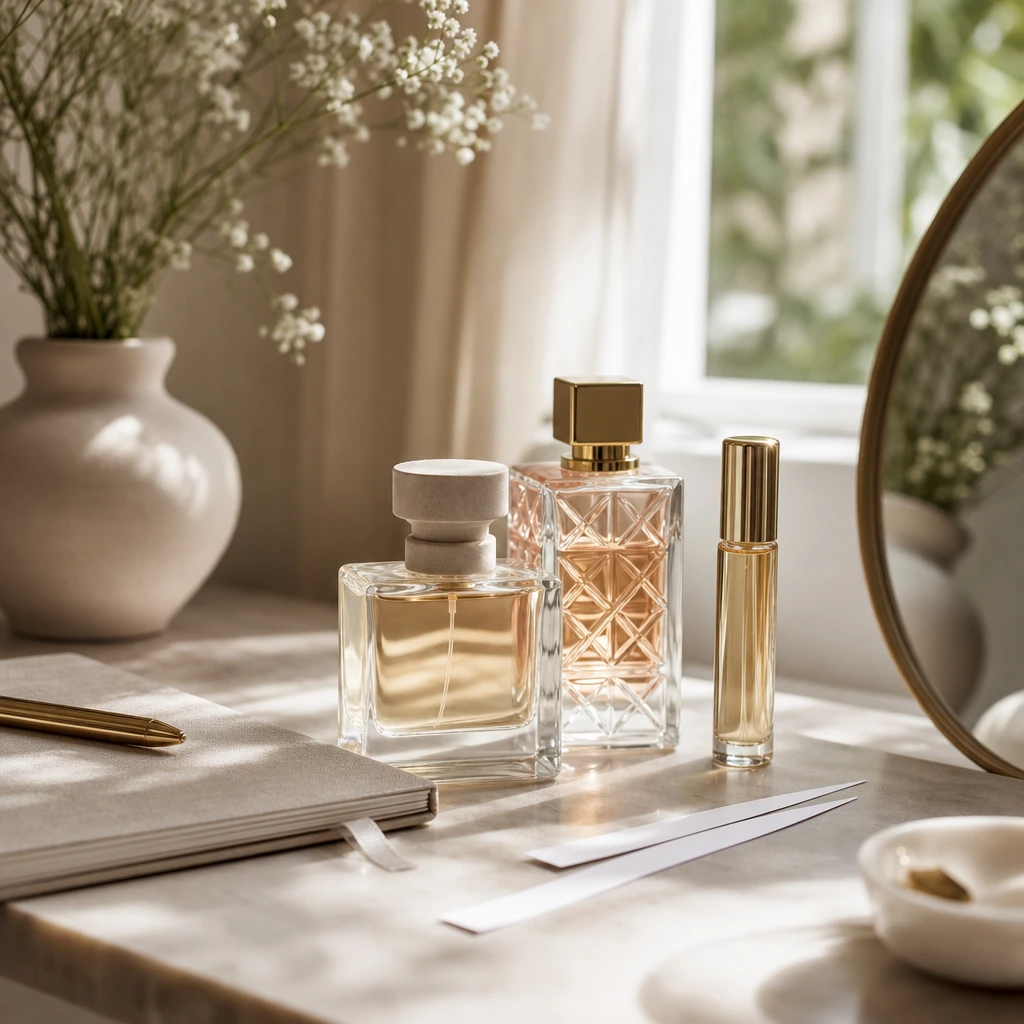
September 25, 2026
Scent Stacking in 2026: How to Layer Perfume for a True Signature Scent
September 25, 2026
Scent stacking—also called perfume layering—has moved from a niche hobby into a mainstream way people build a signature scent. The shift makes sense: fragrance lovers are sampling more, collecting more travel sizes, and chasing a result that feels personal rather than “whatever’s trending.” Trend coverage is also pushing the term into everyday beauty language, which means more people are experimenting—and just as many are ending up with blends that smell muddled, too sweet, or gone in an hour.
At N.O.S.E. Notebook, we see the same pattern in discovery: most people don’t need a bigger collection; they need a better system for wearing what they already own. Layering is one of the fastest ways to get there—when it’s done with intention.
Layering works because fragrance is built in stages: top notes lift first, the heart blooms next, and base notes anchor the whole experience. When you combine two scents, you’re essentially editing that structure—amplifying certain facets, smoothing rough edges, or extending the drydown.
A good stack can:
What it can’t do: turn a perfume you dislike into something you love. If the DNA annoys you—sharp sweetness, screechy florals, heavy smoke—layering may disguise it for a few minutes, but it usually returns.
The most reliable approach is a two-step stack:
1) Choose a base (the anchor).
This is the scent that will read as “the main character” for most of the wear. Bases tend to be:
2) Add a boost (the modifier).
The boost is the accent that changes the vibe—freshness, spice, fruit, a clean shower effect, a darker edge. It should be simpler or more directional than the base, so it doesn’t fight for attention.
If you’re new to perfume layering, start with two fragrances max. Three is possible, but it’s easier to end up with a “department store air cloud” effect—lots of perfume, no clear shape.
One reason layered scents turn muddy is that they’re literally mixed together on the skin before they have a chance to develop.
Try one of these cleaner techniques:
And a practical note: if you’re testing a new stack, use one spray less than usual of each perfume. Layering increases total concentration even when each scent is “light.”
The fastest way to predict a good stack is to look for a shared “bridge” note or a compatible texture.
Think in terms of these matches:
If both perfumes are loud, complex, and constantly shifting, they’ll compete. A great stack usually has one stable scent and one interesting one.
Rather than chasing endless “best layering combos” lists, it helps to build a small capsule per season—two or three reliable bases and a few boosts. Here are directionally useful ideas that work across many brands and styles.
Fall layering is about warmth with definition—comforting without getting heavy.
Winter stacks shine when the base is strong and the boost adds nuance.
Spring layering is easiest when the boost is crisp.
Summer stacks should prioritize diffusion and comfort—especially in heat.
People often search “make perfume last longer” and end up over-applying. Layering can improve longevity, but the trick is supporting the base, not drowning the top.
A few approaches that work:
Also: heat, fabric, and hair all change longevity. A light spritz on clothing can extend wear, but test first—some formulas can stain delicate fabrics.
Most layering failures come from one of three issues:
Mistake 1: Two sweet scents at once.
Result: cloying, sticky, “everything at the same volume.”
Fix: pair a sweet base with a clean, dry, or bright boost.
Mistake 2: Spraying both perfumes in the same spot.
Result: muddy, indistinct, oddly sharp.
Fix: use different zones or stagger timing.
Mistake 3: Testing a stack only in the first 3 minutes.
Result: you judge the opening, but hate the drydown later.
Fix: give it 30–60 minutes. The real verdict is the base.
The hard part of layering isn’t the spraying—it’s remembering what worked. The fastest way to build a signature scent is to track your experiments like you would recipes: what you wore, how many sprays, where you applied it, and what happened after an hour.
That’s exactly why we built N.O.S.E. Notebook around discovery and organization: scan and identify bottles, save them to a personal fragrance vault, and use your evolving scent profile to refine recommendations over time. A signature scent isn’t found once; it’s built.
Scent stacking in 2026 is less about copying viral combinations and more about designing a scent that fits your day, your wardrobe, and your taste. Start with a base + boost, apply in separate zones, and judge the drydown—not the first spray. With a little structure, perfume layering becomes an easy habit that makes every bottle in your collection more useful.
For anyone building a signature scent (or trying to identify and catalog what’s already on the shelf), the N.O.S.E. Notebook team is here online across the United States—helping fragrance lovers discover, track, and refine what they love.
Find your next scent
Browse scent profiles, notes, and houses — or let the Scent Finder match you to a fragrance in four questions.

October 14, 2026
Perfume finder apps have leveled up fast: smarter AI, better bottle scans, and collection “vaults” that help you remember what you own (and what you actually love). Here’s what to look for in 2026—and how to choose the right app for your scent journey.

October 12, 2026
Finding a signature scent doesn’t have to mean buying a dozen discovery sets and hoping something clicks. Here’s a modern, realistic process—powered by a clear scent profile and smarter recommendations.

October 9, 2026
Trying to identify a perfume bottle from a photo? Here’s how perfume scanner apps work in 2026, how to scan bottles and labels for accurate matches, and how to fix the most common scan errors—especially when flankers and lookalike bottles confuse results.